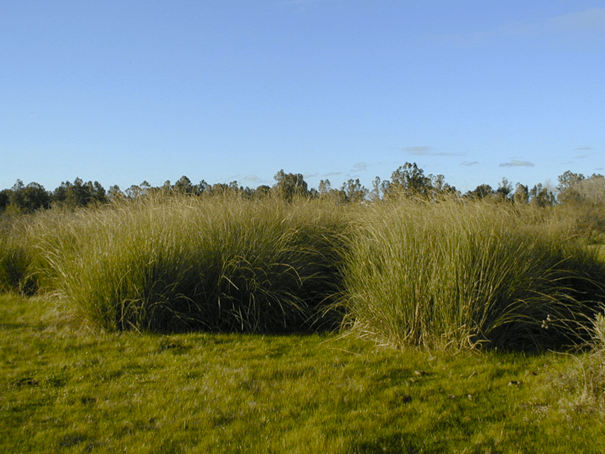
So much water!!!
Uruguay is a water rich country. It sits on the Rio de la Plata, the estuary of the Rio Uruguay and the Rio Paraná. It also shares one of the largest aquifer (3rd largest according to Wikipedia) with Brazil, Paraguay and Argentina: the Guaraní Aquifer. This massive system of aquifers covers 1,2 km2 with an estimated volume of 40.000 km3 (almost double the volume of all the Great Lakes!). This is also the only mayor groundwater reservoir globally to have a transboundary agreement for its safe management and use. Uruguay has an annual mean precipitation of 110mm, with a tendency towards an increase. While many European countries will be facing a reduction in rainfall in particular, in the summer months, Uruguay has been and, according to IPCC trends, will be getting more rainfall.
And then there was a drought…
Uruguay can rely on more than 170 billion cubic meters of renewable water. Uruguay has so much water that 60+% of its energy production comes from hydropower plants on the Rio Negro and Rio Uruguay. Uruguay is one of the few countries in Latin America and the Caribbean where the entire population has access to clean water (https://www.cia.gov/the-world-factbook/countries/uruguay/ ). And still, in 2023 the capital, Montevideo, almost ran out of water. After three years of drought the major reservoir (Paso Severino) that feeds the single water treatment plant was drying out. The government delayed declaring a state of emergency and fed the population (after all half of the country’s population live in the capital…) brackish water by pumping water from the river downstream of the water treatment plant (rather than from the upstream portion where no more water was coming from). This entailed changing the water regulations and after being told off by the High Commissioner of Human Rights of the United Nations, the government started handing bottled drinking water out for free to the vulnerable and poor. Read more about the water transfer project the government started to increase the fresh water volumes upstream and how it affected our farm land in these LinkedIn posts I made last year https://lnkd.in/edTM3GXc; https://lnkd.in/euzef89Z; https://lnkd.in/dYsdTAN2.
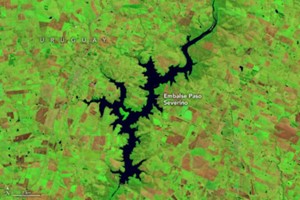
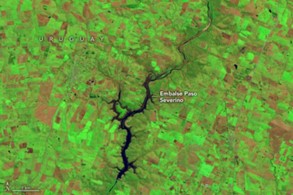
Volume of water in June 2022 vs June 2023. Courtesy to the satellite images of NASA
Cause and consequence
Now, how could it get so bad? Of course, there was a drought and lack of rainfall. But, of the 500,000m3 of water per day that are treated and distributed about half are lost in broken pipes and are generally declared as non-revenue water, a fact that was finally acknowledged once the state of emergency was over and plans were made to work towards the reduction of water loss. One of the most important water and environmental scientists in Uruguay, Daniel Panario, already pointed out several issues way before the crisis began. Read his statements here (in Spanish). He basically says, we need to change the focus away from the big money-making entities that will take the money and stick it in banks abroad, but rather focus on harnessing the small producers, which are largely the ones that are feeding the population.
Land use changes in the last 3-4 decades away from extensive grazing and moderate agriculture towards intensive systems of GMO grains, feedlots and high-production dairy reduced the capacity of the land to retain water and liberate it slowly. In a small but illuminating article, Schön et al. (2020) showed that an increase in precipitation alone could not explain the changes in the flood regime of the Rio San Jose, one of the tributaries of the Santa Lucia, the drinking water source of the capital. Rather the shifts away from extensive land use towards more intensive ones in particular in the upstream portion of the rivershed reinforced the reduction in the time till peak flood was reached and also increased the frequency of high flood events. Grasslands and its preservation play a major role in maintaining the water regime. Read my blog about how grasslands are disappearing in the Pampa and why this is an issue.
Solutions
The water supply situation around Montevideo was known for decades. Most governments were lucky enough that it started raining rather sooner than later. When the previous government left office in 2019/2020 they handed the new government a fully financed project to built a new water storage facility (Casupá) on the same watershed as the current one, but it wasn’t implemented. Instead, the government went ahead with what is known in the country as Arazatí or ‘proyecto Neptuno’, a water extraction system from the Rio de la Plata, a water source that will most likely not suffer from water shortage. However, it may suffer from water quality problems when the winds and the tide press the sewage water from Buenos Aires across, from salinity issues that will increase with sea level rise and from cyanobacteria algal blooms coming from the pollution loads of the Rio Negro (forestry and agriculture…. again….). It’s execution, through private, rather than public funds is also questioned to be against the constitution, as Uruguay has a human right to water enshrined in its constitution and explicitly demands water for human use to be solely in the hands of government entities. In a marathon session of more than 12 hours the government decided for the implementation of this project even though large criticism remains. But actually, it doesn’t quite matter from both an ecological and social standpoint which water capturing plant to put in place – both suck, demand the expropriation of hundreds of people, flood large areas of native forests and grasslands, jeopardize archaeological sites and don’t really consider the footprints they entail. The Neptuno project plan highlighted that more than a third of the issues it detected would cause irreversible damage and would be detrimental to the area. In a brilliant thought piece by Luis Aubriot of the Faculty of Sciences of the Universidad de la República, he stated that neither project complies with the ‘Golden Rule’, in which the water supply to a mayor urban centre is secured by not one but two water treatment plants and for either to provide at least 70% of the maximum demand. Either project will still pump water to Aguas Corrientes, the unique water treatment plant inaugurated in 1868!!!
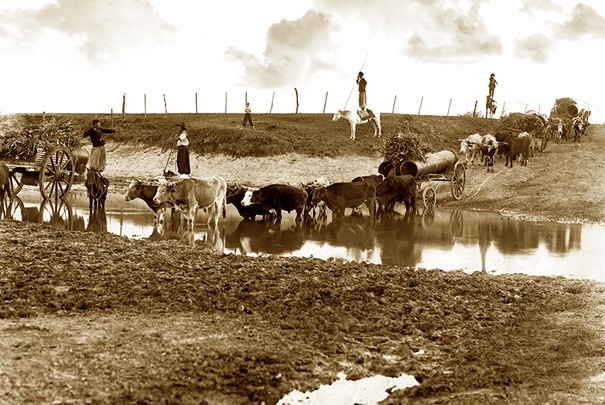
Credit to OSE http://www.ose.com.uy/empresa/historia
Recommendations
So, can we stop fighting over the wrong solutions and start thinking more holistically, including halting land use change, reducing pollution loads, cutting down on excessive water use (average water use is still more than 100 Liters per person per day of a person in Montevideo…), thinking in circular systems, reusing water, curbing demand rather than catering to an increase in supply. The rivers will continue running dry and not only people suffer – the first ones to suffer are the ecosystems… More on wetlands will follow.
In this article (in Spanish) with Katrin Lammers, Martha Hoffmann and Paula Collazo, we gave the following recommendations about dealing with water in Uruguay:
- Secure resilient water supply for the population. Establish an inter-disciplinary expert committee for the long-term development of a resilient water supply and sanitation system and management of Montevideo and the country’s other cities. To aid implementation of the management plans, the institutional capacities of the national water company (Obras Sanitarias del Estado OSE) should be increased by expanding the personnel beyond civil engineers. Faulty infrastructure, for example the leaking pipe system of the capital, must be fixed.
- Strengthen River Basin Organisations (RBOs) for local participation. Empower the RBOs by realising their constitutionalized decision-making power. Additionally, new RBOs should be established for currently unrepresented aquifers, for instance for the Raigón, Arapey and the Uruguayan part of the Guaraní aquifer.
- Establish resilient long-term water management plans. Develop management plans for surface and subsurface water use that are based on scientific evidence of the hydro-geological variations in extent, volume, quality, and capacity of renewal. This should consider impacts of climate change as well as changes of infiltration capacity due to land use alterations. Strategic water reserves should be established. Following the Constitution, access to drinking water must be prioritized.
- Increase research and expert knowledge on environmental issues (funding for local and international research). A special emphasis should lie on inter- and transdisciplinary research based on long-term monitoring of surface and sub-surface water quantity and quality. Additionally, fostering the study and practice of environmental law is crucial to increase the number of environmental lawyers in Uruguay, which then can represent civil society in case of environmental conflicts.
- Capacity building and Environmental Civil Society. Empower non-governmental and civil society organizations to come together around environmental issues and support local action for environmental awareness-building. This support is direly needed, as current organisations tend to be small and dispersed, while international organisations remain absent. In the long run, this could reinforce environmental issues in political debate and representation.

 Tamara Avellán
Hinterlasse einen Kommentar