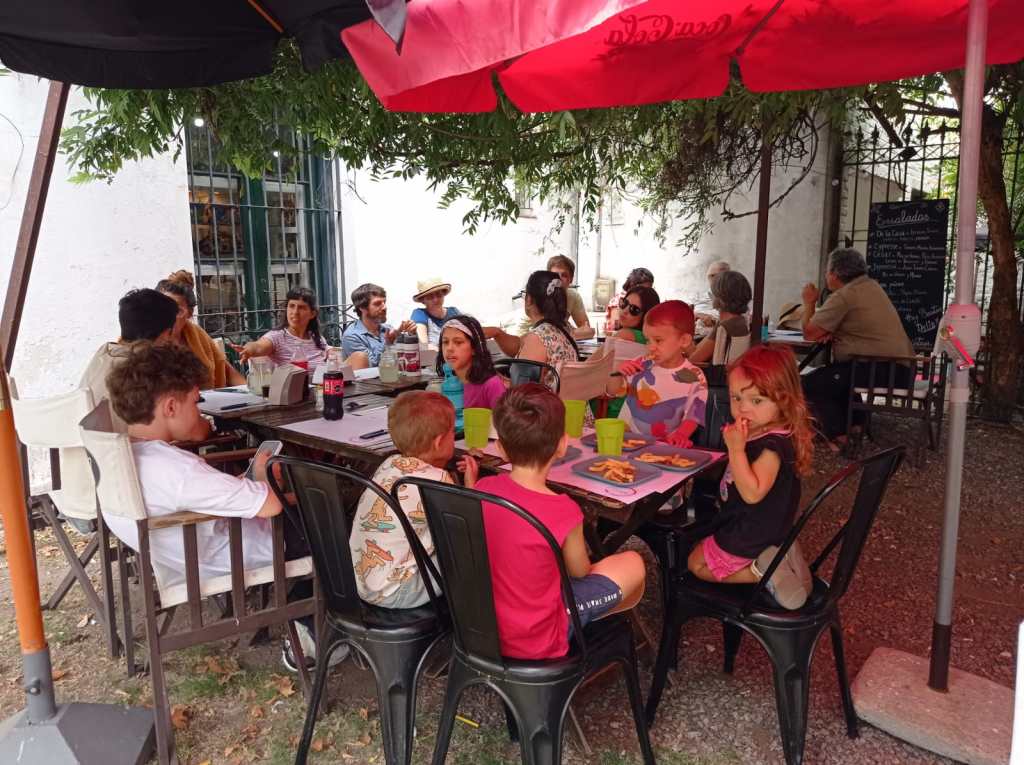
I grew up mostly with my inner-circle family: my mom and dad, and my big brother. We were too far away from my Uruguayan, German or my Nicaraguan family members (the latter spread out throughout the US and Central America). I got to see my mother’s Uruguayan side of the family only on those trips and my extended stays in South America (high school in Argentina, a few years in my late twenties when my son Noah was small). But I have always loved, and still do, the family gatherings for birthdays, Christmas, or whatever other occasion we would come up with. My mother has 4 further siblings each now being grandparents themselves. The image above shows a subset of that family in Colonia del Sacramento last weekend, where one of my cousins lives with his family (it was one of the kid’s birthday). Colonia is a fantastic little gem of a colonial city at the edge of the Rio de la Plata. Many day tourists from Buenos Aires take the ferry across to take in the flair of the old city which has been restored and preserved very nicely. The UNESCO world heritage site is worth the stint.
Animal families
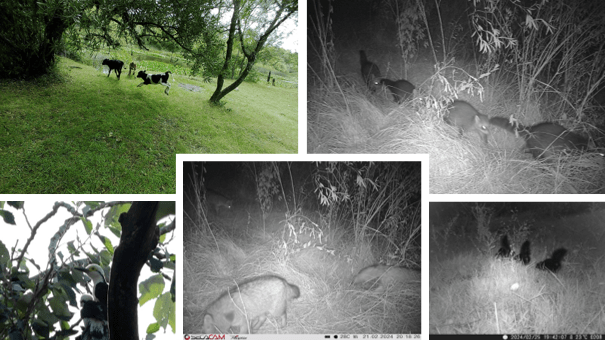
Our cameras have been picking up lots of fantastic wildlife – and loads of families. Ron has been tirelessly searching for the skunk, getting up early, sitting outside quietly waiting for it while being devoured by hungry mosquitoes, only to be deceived by the shortsighted Conepatus chinga by choosing different unexcepted paths. Finally, on a nightly bathroom wake, he was recompensed by not only seeing one, but a whole family of skunks right in front of the window (bottom right)! The other animal that had had Ron ticked off the last days was the family of White Woodpeckers (Melanerpes candidus) that were teaching their chicks how to fly. They were simply always too far away to get good pictures. Finally, he caught them picking ants and bees of the tree trunk (left bottom).
Our wildlife cameras also rewarded us with some awesome pictures of a family of crab-eating foxes (Cerdocyon thous) technically actually not in the fox family but rather in the family of hounds or dog-like animals (Canidae) (bottom middle). We have seen lots of foxes on camera – pretty much every night on any of the three cameras that we have now set up – even close to the house. And I finally got to see my dear manopelada (Procyon cancrivorus), one of two species of racoons living outside of the Caribbean Islands (the other one is the North American racoon that is invasive in Europe for instance). I had so far only seen their footprints which look like small hands when I find them in the mud. Thus, here a full family of four (top right picture) and very proud to see them reproduce as they are actually considered to be vulnerable on the IUCN list for Uruguay. One more reason why this entire region is in a protected area. Want to see more wildlife pics: donate to my gofundme so that we can expand the sightings.
And not to forget, that this is farmland. There are cows and their calves grazing in the 30ha large area of the floodplain. Silvopastures are considered as one of the sustainable ways of livestock management which is not only good for the animals but also for landscape management, keeping open grasslands while providing shade to the animals and reducing the advancements
of invasive species. As you can see from the picture, the calves are happily jumping around 😊
Gauchos and Indios
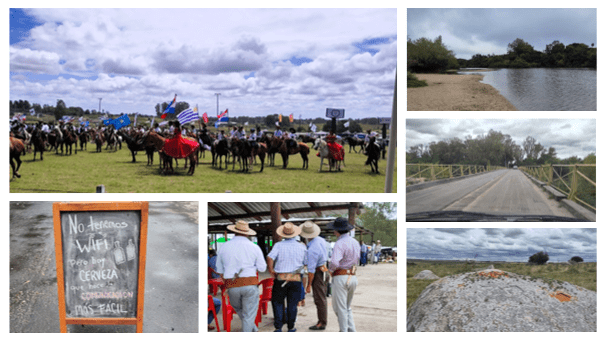
As mentioned in my previous blog, we went full deep dive into Uruguayan folk and rural live to the 50th Folk Festival in Durazno. It was a blast to see all these Gauchos and Chinas around us in amazing full vaquero dress. We of course went along and got ourselves bombachas (pants) and a boina (hat) for Ron. The folk festival surpassed all expectations and around 100.000 people came to see stars like Soledad and Catherine Vergnes play their tunes. I was most impressed by the Payadores, two men and two guitars that basically ‘battle’ each other like in Hip Hop with their rhymes and whit (here a ‘short’ only 13 min long session in Argentina). We stayed in the municipal campground next to the River Yi embedded in the native forest with some majestic and beautiful trees and a fantastic beach on the river, crossed the old wood bridge and visited the museum of Fructuoso Rivera. Rivera was the first president of Uruguay and actually governed from Durazno and not from Montevideo. While respected for his military and diplomatic deeds, he was basically the one who slaughtered all of the indigenous population that was left. In the battle or killing of ‘Salsipuedes’ (which basically means ‘get out if you can’) in 1831 at least 40 individuals (most likely head of tribes) of the Charrúas were killed and more than 300 taken prisoners. Some of the prisoners were then sent of to Paris to take part in the ‘Human Zoos’ at the show entitled ‘Los últimos charrúa’ (the last charrúa). Uruguay has basically no indigenous population left (about 1% of the Uruguayan population is considered indigenous).
In the National Park of Chamangá, southwest of Durazno, remains of prehistoric art can be found on the large stone boulders that seem like they were thrown into landscape by giants playing dice. Some 40 paintings have been recorded on these stones and seem to be more than 1500 years old – amazing as they are not protected from rain nor sun. We stomped about but didn’t find a single painting – apparently this is best done with expert archaeologists. We sincerely hope that this area will be better accessible and explained to the population at large. Uruguay and Uruguayans may want to connect a bit deeper with their pre-historic times to be able to value what has been there before ‘the white man’ came and to think about how colonialization and colonialism is still engrained in their way of life…
And just like that, our first month is already over! March will bring wedding party preparations, a final project conference, project evaluations, and the start of the school year here. I am looking forward to the conversations with the schools and how we can work together. So many ideas in my head!!!

 Tamara Avellán
Hinterlasse einen Kommentar