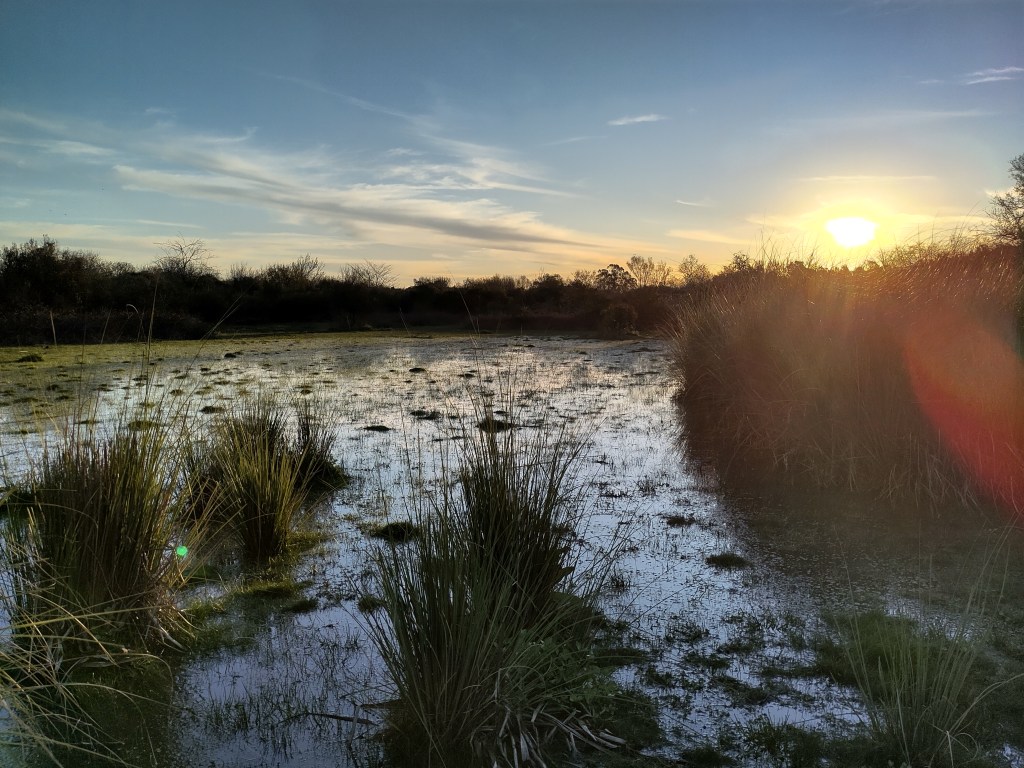
The world is not on track with water. Climate change is only exacerbating this situation. While a war in the world’s breadbasket is causing severe hunger in the Global South, heat waves in Europe are reducing grain yield quality. Water security (access, quantity and quality) are key to global security. Lack of water or lack of access to enough good quality water are causes for social unrest if not war. Water is essential for life on earth – it is essential for peace. Technical or biophysical views of water are not enough to strive for peace.
My research activities over the past 2 decades have been diverse, addressing the intersections of water, land use, ecological health and ecosystem services, wastewater reuse, constructed wetlands, agricultural yield, and climate change. However, I have always been interested, apart from bio-physical changes, in the role of human behaviour in finding solutions and therefore to understand participation, knowledge co-creation and engagement of stakeholders. I have married both sides through Nexus research and its important contribution to achieving sustainability.
Check out some of the projects below in which I have been involved, which I have developed and/or led.

My research focus lays in the following three areas:
(1) Integrating frameworks on sustainability of water management/water management for sustainability.
Sustainable water management is crucial to achieve sustainable development – and this explicitly includes wastewater management. It is a self-reinforcing loop. For water management to be sustainable we need novel management approaches that move away from being techno centric. To measure success sustainability assessments can help. In the BMBF -funded project SludgeTec we developed and tested a sustainability assessment for wastewater treatment systems (see Benavides et al. 2019). In the EU H2020 project WATERAGRI we implemented multiple different sustainability assessments to assess the degree of sustainability of various technical solutions for water and nutrient management in 10 European case study sites. Understanding the diverse information that these different assessments provide and how to then answer which solution is sustainable for which context, remains a challenge, but can be solved through index building techniques (Dencker 2023). In addition, other criteria such as diminishing the risk of enduring a water scarce situation may influence decision-making and drive the implementation of potentially unsustainable solutions (Müller et al. 2022). Nexus research and its paradigms of inter- and transdisciplinarity and of knowledge co-generation can help solving water ‘issues’ by reframing them and putting them into broader resource and sectoral contexts (Avellan et al. 2022) such as the integration of Ecosystems (Lucca et al. forthcoming).
(2) Integrating data to overcome barriers to constructed wetlands implementation
Unconventional Water Resources can exhibit a variety of regional benefits when the local conditions are apt for it (i.e. fog harvesting in the Pacific Andes) (Karimidastenaei et al. 2022). In my research on nature-based solutions for pollution control, i.e. constructed wetlands, I have shown that they manifest diverse reuse potentials (water for irrigation, energy production from biomass) (Avellan and Gremillion 2019). But we can also see that reuse alone does not make a system automatically more sustainable (Avellan 2023 – Habilitationsschrift). Barriers to implementation of constructed wetlands in developing countries lay in the lack of adapted guidelines and calculation methods, as well as in unclear or opposing legislation and a perceived lack of trust into the technology by decision-makers (Turcios et al. 2022). In the ERANet LAC project CWetlandsData, originally written and gained by me and then transferred to Prof Papenbrock at the Leibniz University of Hannover, we developed a web-based platform to gather and visualize (technical) information about constructed wetlands (https://data.cwetlandsdata.com/). While this platform depends on experts to provide their data, automated data extraction mechanisms can help obtain critical information directly from peer-reviewed journal articles (Nevado et al. 2019). Additionally, citizen science approaches can help obtain field data when implemented appropriately (Capdevilla et al. 2020) since we know that institutional capacities for data collection, processing and reporting of water quality parameters varies with the Human Development Index (Kirschke et al. 2020). To raise capacities, CWetlandsData has developed a serious game fostering knowledge generation and teamwork. Constructed wetlands are useful systems for urban and rural contexts. Smart drainage water from agricultural fields collected during high rainfall events can be cleaned and used for irrigation purposes during drought instances (Mustafa et al. 2022). To implement constructed wetlands sustainably subsidies may be needed in the European agricultural context as we showed in a Policy Brief co-written with colleagues at the United Nations University Institute on Comparative Regional Studies UNU-CRIS.
(3) Integrating participatory practices for ‚technical‘ problems
Water management is a sustainability question. Sustainability research advocates for transdisciplinarity. Participatory practices to solving seemingly ‘technical’ problems such as mal-functioning wastewater treatment systems are, however, not common practice. In SludgeTec we showed that the technical problems could be easily solved, but that socio-economic issues hampered the sustainability of the systems (Avellan et al. 2019). Co-generation of knowledge and social contracting are the current research frontier in Nexus projects. As such, in the EU H2020 project NEXOGENESIS we are developing, implementing and testing a stakeholder engagement mechanism to foster knowledge co-generation for Nexus governance and policy in 5 transboundary river basins. We know that perception of engagement by stakeholder may differ from the one intended by the researchers (Hahn et al. 2023). And we are seeing a strong bias towards high interest stakeholders through the mandatory consent process imposed by the General Data Protection Regulation (GDPR) of the EU (Avellán et al. in review). Participatory processes are resource-intense and natural science researchers sometimes poorly trained or aware of the usefulness of stakeholder information or participation. Similarly, capacities to deliver or take up evidence-based policy recommendations may not always be given or not be suited and adapted to the needed modes of co-creation . In NEXOGENESIS we assess policy impact amongst other tools through the operationalization of a competence framework developed by the EU Joint Research Center.
 Tamara Avellán